The difference between semi-solid, quasi solid, and all solid state batteries
 Release time:2026-02-25
We often see in the media and online that a certain company has made a huge breakthrough in solid-state batteries. Alternatively, a company may announce the mass production of solid-state batteries by 202X. Perhaps they only dare to say that it is a solid-state battery, and dare not say that their battery is an all solid state battery.
Solid state batteries can simply include (semi-solid, quasi solid, and all solid state batteries), and in order to appear high-end and attract attention, they directly refer to solid-state batteries.
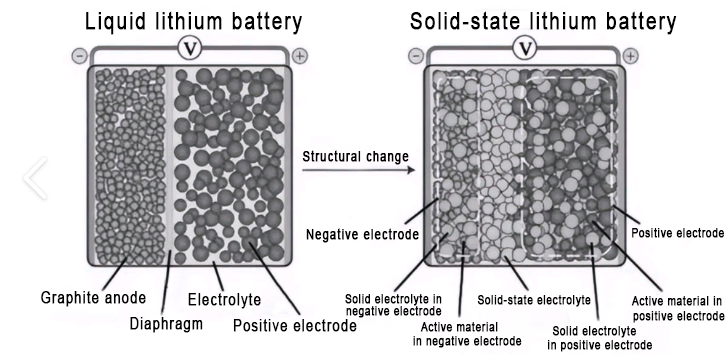
What is the difference between the three?
The core difference between semi-solid, quasi solid, and all solid state batteries lies in the physical state of the electrolyte, ion conductivity, interface issues, and industrial maturity.
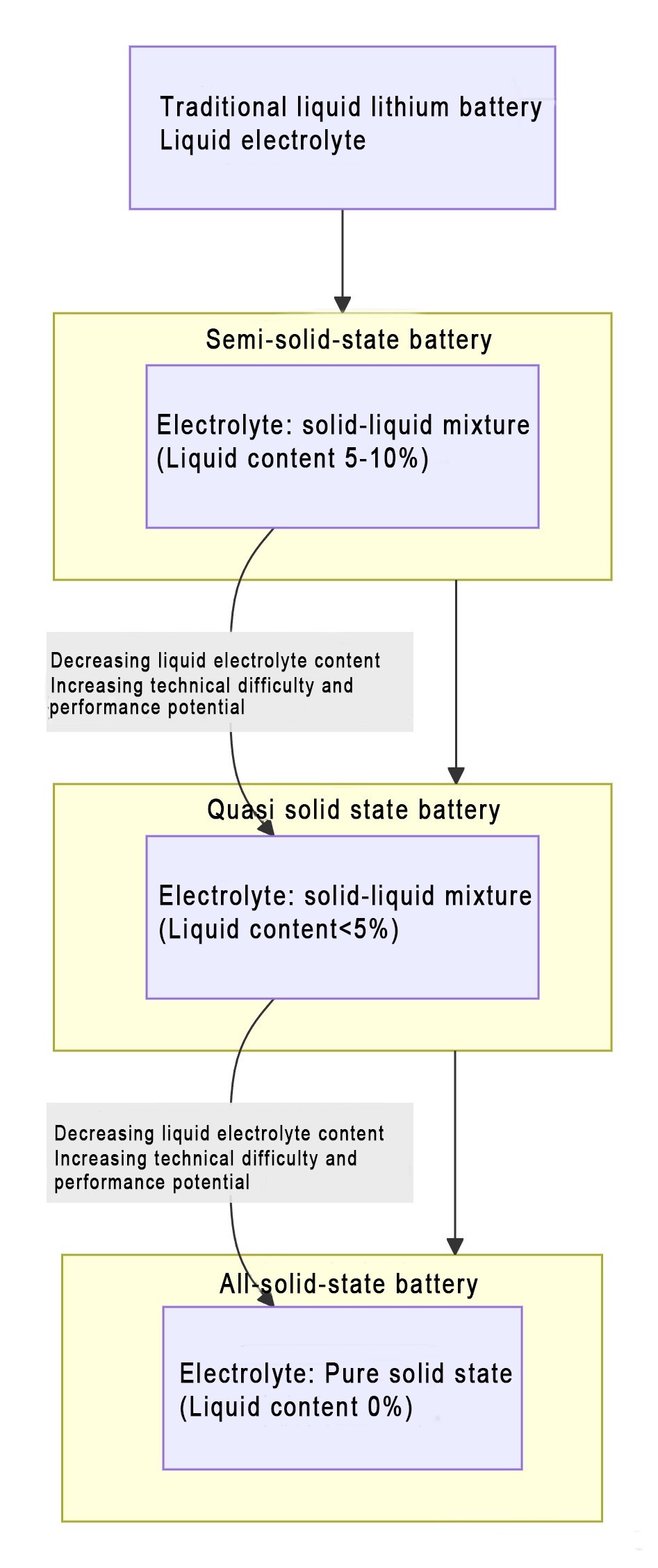
The following comparison chart can clearly summarize the core differences and evolutionary relationships among the three:
Detailed explanation of core differences
1. All solid state battery
Electrolyte state: 100% solid, without any liquid electrolyte. Solid electrolytes such as oxides, sulfides, or polymers are usually used.
Key features:
Highest safety: completely eliminate the risks of leakage, combustion, and explosion (especially when using metal lithium negative electrodes).
The maximum potential for energy density: compatible with high-voltage positive electrodes and metal lithium negative electrodes, theoretically with an energy density of over 500 Wh/kg.
The interface problem is the most severe: solid solid contact leads to high interface impedance, difficult ion transport, and the biggest challenges are rate performance and cycle life.
Cost and process are extremely difficult: the preparation process is complex (such as the processing of brittle electrolytes, thin film preparation), the cost is extremely high, and mass production is the most difficult.
Current situation: In the research and development and pilot stage, it is widely recognized as the "ultimate solution", but the road to commercialization is the longest. Representative companies: Toyota, QuantumScape。
2. Quasi solid state batteries
Electrolyte state: "quasi solid" or "gelled", containing a small amount (usually<5%) of liquid electrolyte or plasticizer, wetting the space between solid electrolyte particles with a very small amount of liquid.
Key features:
Transitional solution: It can be seen as a preparatory form of all solid state battery. It sacrifices "absolute solid state" in exchange for more feasible interface performance.
Interface improvement: Trace amounts of liquid greatly enhance the ion transport capability of the solid solid interface and reduce interface impedance.
Performance Balance Point: Seeking a feasible balance between safety, energy density, and electrochemical performance. Its energy density and safety are still significantly higher than liquid state batteries, but slightly inferior to ideal all solid state batteries.
The manufacturing process is relatively friendly: closer to existing production lines than all solid state.
Current situation: Often overlapping or mixed with the concept of "semi-solid", it is a crucial step for many enterprises to move from semi-solid to all solid state.
3. Semi solid state batteries
Electrolyte state: solid-liquid mixture, coexistence of solid electrolyte and liquid electrolyte, with high liquid content (usually>5%, even up to 10-20%).
Key features:
Compromise and improvement plan: Essentially, it is a "heavy improvement" of existing liquid lithium-ion batteries, rather than a subversion. Solid electrolyte coatings or composites with electrode materials are commonly used.
Improved safety: The quality of liquid electrolysis has been reduced, reducing the risk of combustion, but it has not been completely eradicated.
Significant improvement in energy density: High capacity positive and negative electrode materials (such as high nickel and silicon carbon) can be partially applied, with an energy density of 300-400 Wh/kg.
Compatible with existing production lines: The production process adjustment is relatively small, making it the first route to achieve commercial mass production.
There is still a risk of leakage: essentially still belongs to the category of "liquid batteries".
Current situation: It has entered the stage of mass production and installation. Representative applications: NIO's 150kWh semi-solid battery pack (Weilan New Energy), Lantu Chasing Light (Ganfeng Lithium), etc.